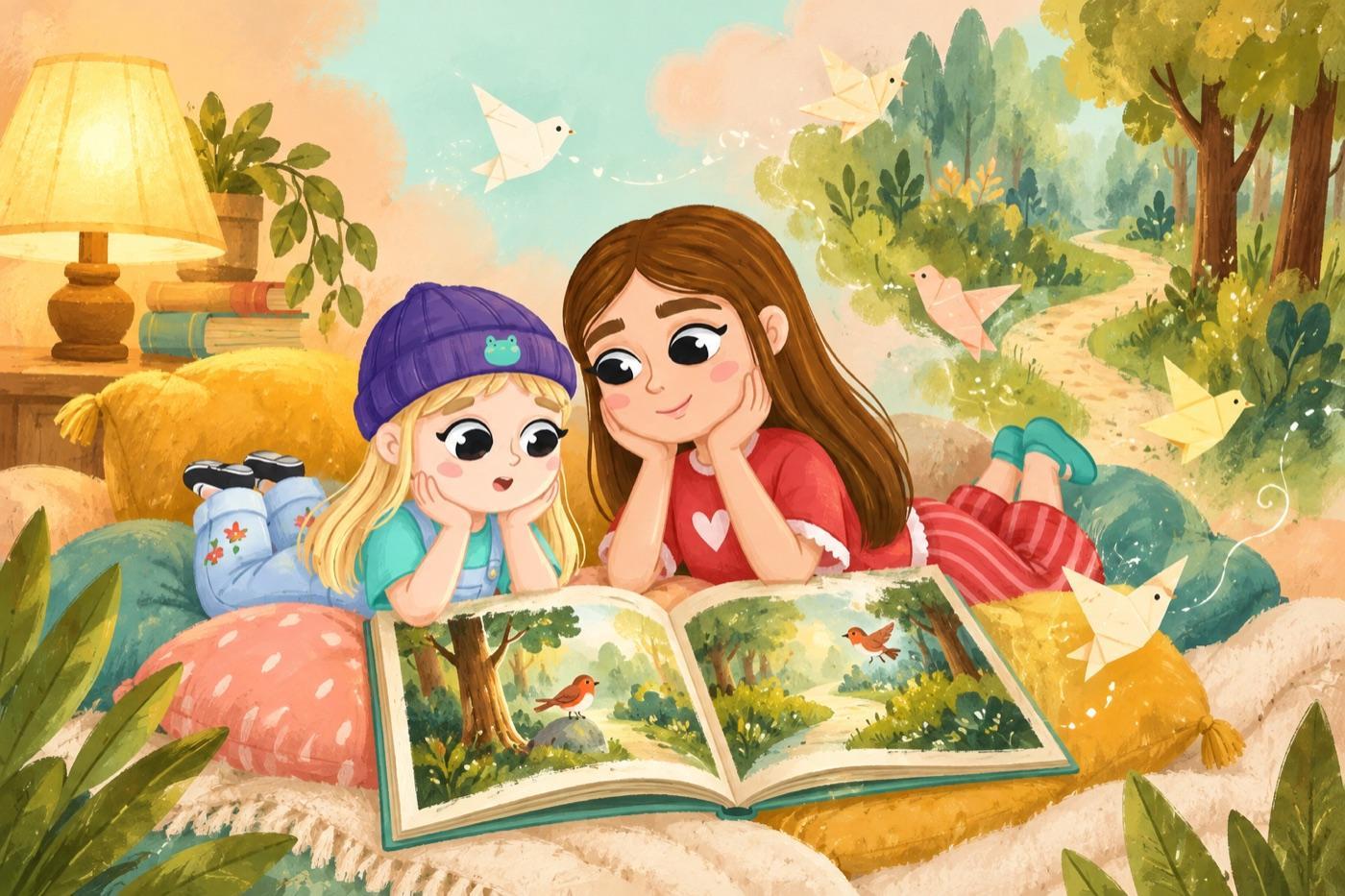

If your family shares stories in two languages, explore the practical options in Reading in a bilingual family: one story, two languages. A wordless picture book tells its story mainly through illustrations rather than paragraphs of text. When exploring one together, notice what changes: a character, a place, an object or a movement. You do not need to invent a complete narration immediately. Begin with one detail, then turn the page to see what happens next.
This is a different format from a picture book with short written passages. Both can belong on a family bookshelf. Here we explore how images carry a story. This is not an assessment of a child's development or a promise that a particular book will resolve communication difficulties.
What makes a picture book wordless?
The story has no conventional narrative text, or uses very few words. A cover may still include a title, an author and publishing information. Wordless usually describes the storytelling format, rather than the absence of every printed character.
Reading Rockets introduces the format as an opportunity to create a narration around illustrations. Instead of reading the same printed wording, different readers can describe a scene differently. A contribution does not have to be long or spoken aloud to be part of the shared experience.
How can you spot the detail that moves a story forward?
Choose something that appears again on the next spread. It might be a red umbrella, a bird at a window or a character carrying a bag. Notice whether it stays in place, disappears or appears somewhere new. A picture can show movement without a sentence saying that someone went outside.
Imagine two spreads: a small toy boat sits on a table in the first, then floats in a puddle in the second. You could say that someone carried it outside, or simply point to where it is now. This is an invented example to explain the format, rather than a description of a published book.
Do you have to make up a spoken text?
No. Looking, pointing and saying a few words are all possible ways to explore. If you want to narrate, start with one short sentence about what you see. Leave the next event open. Your child can add an idea, turn the page or remain with the picture.
In a family using two languages, you can describe the same scene in either language. There is no need to compare who used more words. If you prefer a written story, our picture books about feelings offer another route into shared reading.
How do you choose a first wordless book?
Look at a sample before buying or borrowing. Choose a subject your child enjoys and illustrations that you find comfortable to follow. Some books use a clear sequence of scenes; others contain many small stories at once. Neither approach is automatically better.
A librarian can help you look for wordless picture books. Check the title and available edition in the local catalogue. Our home bookshelf guide offers further ideas for mixing formats, rather than buying a shelf of similar books.
How does TAMITOS fit in?
TAMITOS Príbeh porozumenia is our illustrated book with text, not a wordless picture book. You can still pause at an illustration to notice a character, colour or setting. Naming the difference helps you choose the format you actually want.
The TAMITOS book product is currently in Slovak, with a separate Czech edition. This English guide does not announce an English edition. If a character catches your interest, meet the TAMITOS characters on our website. A good shared reading session does not require finishing every page.
Frequently asked questions
Is every picture book wordless?
No. Many picture books combine illustrations with written passages. In a wordless book, pictures carry most of the narrative.
Are wordless books only for very young children?
The format alone does not determine an age. Consider the individual book, the complexity of its images and the reader's interest.
Must we discover one correct story?
You can try your own descriptions while exploring the pictures together. There is no need to turn the activity into a test.
Sources and a next step
The starting reference is Reading Rockets: Sharing Wordless Picture Books. This is an evergreen subject, rather than a new research announcement. Browse a sample of one wordless book, then compare the format with the illustrated TAMITOS book to decide what interests your family.
More ways to spend time together
Explore Free TAMITOS games: what can you play today? and Your first library visit with and child: and simple plan.
A related guide: Reading with two children of different ages.
A related guide: The same book again: sharing a child's favourite.
A related guide: What is audio description? A story beyond the picture.
For a practical next step, see our related guide: A book gift for a child who cannot read independently yet.
Different access formats address different needs. For the way written information can be made clearer, see our guide What is Easy Read? Clear information with useful pictures.